

This month, Meta announced another round of layoffs—8,000 employees impacted as the company continues to invest in AI because Mark Zuckerberg believes “success isn’t a given” in this AI-driven era.
We’ve heard this same story many times before: corporations using AI as a justification to slash human costs, pump up stock prices, and remain competitive in the tech arms race. It has become a depressing norm for corporate workers to expect quarterly layoffs and constantly wonder if they will be next.
The reality is that we are experiencing a collective burnout fueled by uncertainties: rising costs, AI job displacement, and an unstable economy. It isn’t just tech workers who are exhausted; the younger generation is angry, too. Look at the recent commencement ceremonies where new grads openly booed speakers who brought up AI. They are staring down a future where companies choose to invest in data centers instead of young talent.
As a disillusioned millennial who spent a decade in tech, I, too, feel a deep well of rage and sadness regarding our current state of late-stage capitalism. My approach to combating a performance culture I no longer believe in? Making art in the age of AI.
Creative Resistance: Self-Expression as Activism
I originally started building Burnout BFF to address burnout recovery and advocate for more sustainable ways of working. But the deeper my research went, the more frustrated I became. I realized that the root causes of our exhaustion are systemic, and that change feels far away with every new piece of information confirming what a shitty timeline we live in right now (eg. corporations cutting paid time off and parental leave, massive workforce reductions, and the unethical practices of AI companies).
Aside from voting annually, conventional political organizing has never been something I enjoyed. As an easily overstimulated introvert, I am protective of my energy—and being involved in “politics” sits at the bottom of my list. For a while, I carried a sense of guilt that I wasn’t doing more in the conventional activist sense.
My perspective shifted when I came across a zine by Lil_Persefone about “Creative Resistance” that reframed activism for me. It made me realize that what I do every single day is already a form of political resistance.
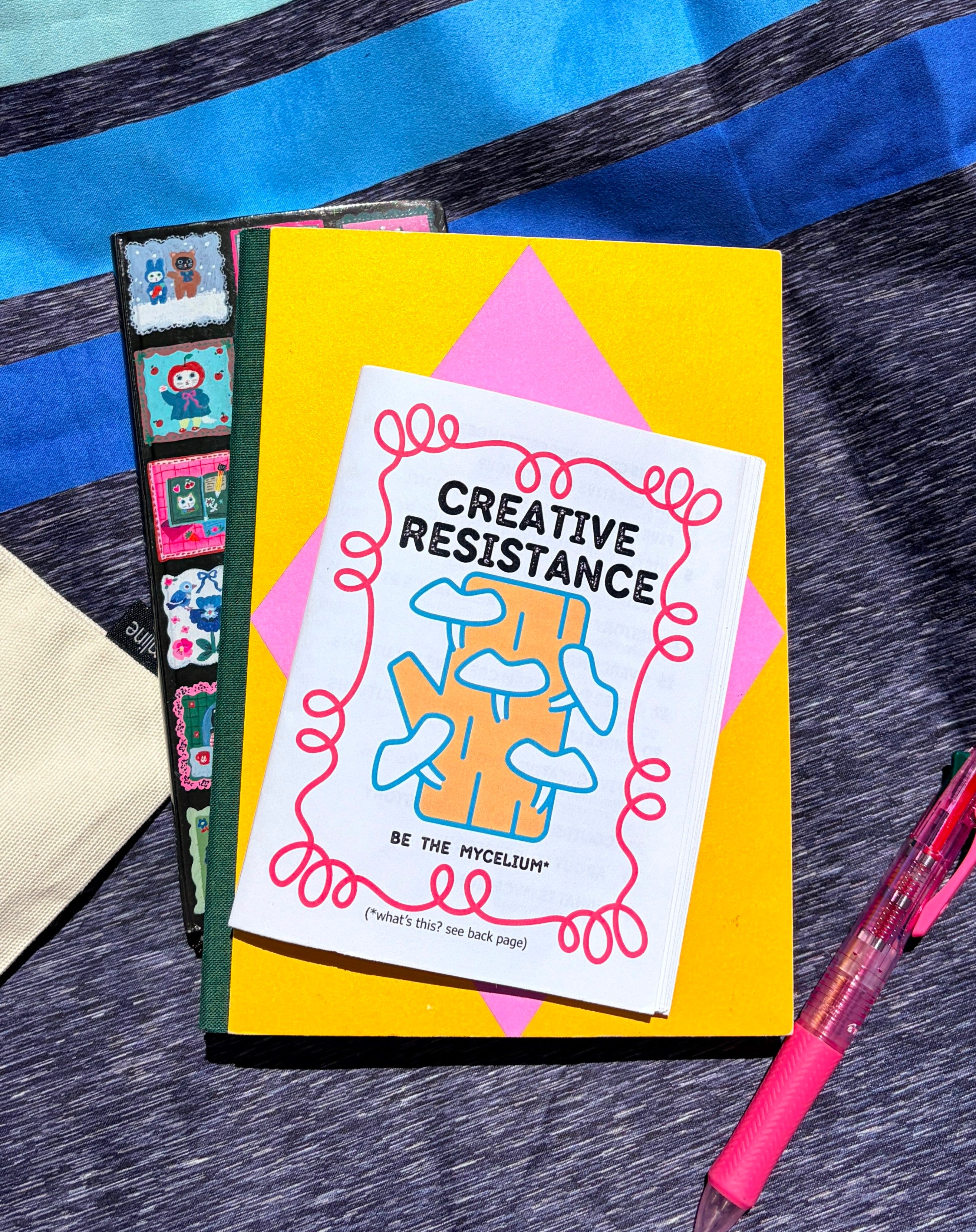
Creative resistance is the act of challenging oppressive authorities, institutions, or cultural policies through creative expression. It is the practice of making your personal values tangible using artistic principles, skills, or tools. —Creative Resistance by the Mycelium


When you look closely, creative resistance is everywhere, and it’s a powerful form of activism. Stand-up comedians and late-night hosts wrap sharp political critiques in humor. Writers and poets move readers with written truths. Filmmakers use documentaries and cinema to expose injustice and influence cultural perspectives. Visual artists and photographers challenge our worldview through their marks and lenses.
You don’t need to be an artist in the traditional sense to be engaging in creative resistance; we all practice self-expression in one form or another. To me, the message that “anyone can participate in creative resistance in their own way” is hopeful and empowering. It offers a much more inclusive and accessible way to think about activism.
Creative Expression as Anti-Capitalism
Humans are inherently creative, and we see that creative spark especially clearly in children. But as we grow up and learn to prioritize metrics imposed on us by educational and corporate systems, it’s easy to suppress our creative intuition in pursuit of performance and productivity.
When I was deep in my burnout last year, being creative was literally what healed me back to myself. Embracing creative practices taught me to stay mindful, anchor myself in the present, and actually enjoy the process rather than constantly optimizing for the output. Reclaiming a creative outlet is an essential part of burnout recovery because it forces us to prioritize self-care and joy.
When capitalism and corporations tell us our worth is tied to our productivity—or our ability to prove we are “better than AI”—choosing to create just for yourself becomes a radical act. Just as being conscious of where you spend your money is a way to resist consumerism, intentionally choosing how you spend your time and energy is a way to oppose capitalism as an individual.
Engaging in creative expression also has real, tangible benefits to our health. Playing heals our nervous systems by keeping us grounded in the present and guiding us into a flow state. Art therapy has been proven to significantly reduce cortisol levels, ease anxiety, and help process trauma by engaging areas of the brain that words alone cannot reach.
Ironically, systemic oppression is designed to make people too tired to engage in creative resistance. When you are too stressed and exhausted to protect time for play, you lack the energy for the very activities that would improve your wellbeing. Burnout is a vicious cycle—which is exactly why reclaiming our creative expression is so important.
Our Advantage Over AI is Being Human
The most frustrating part of how the tech industry approaches AI is that rather than delivering on the technology’s promise to improve the human condition, corporations are using it solely as a tool to cut costs and drive profits. Instead of freeing us from mundane, repetitive tasks so we have more time for leisure and joy, we are being forced to work harder to compete with machines. It feels like we’re watching a corporate version of The Hunger Games play out—everyone is fighting for scraps and trying to prove they can “use AI better” just to survive rounds of layoffs in the name of efficiency.
The reality is that humans will never beat AI at productivity. That is exactly what machines were built for. We cannot out-perform AI in efficiency to thrive in this new era; instead, this is the time to lean into what technology cannot replicate but what people deeply crave: authentic connection, human intuition, creativity, community, and spiritual healing.
This is why I am so deeply committed to my creative practice. AI may be able to mimic a specific art style or generate flawless tables, but it cannot replicate the emotional resonance of authentic art—the shared human emotion and raw energy an uninhibited creator conveys through their work.
The Power of Creative Expression: Healing and Connection
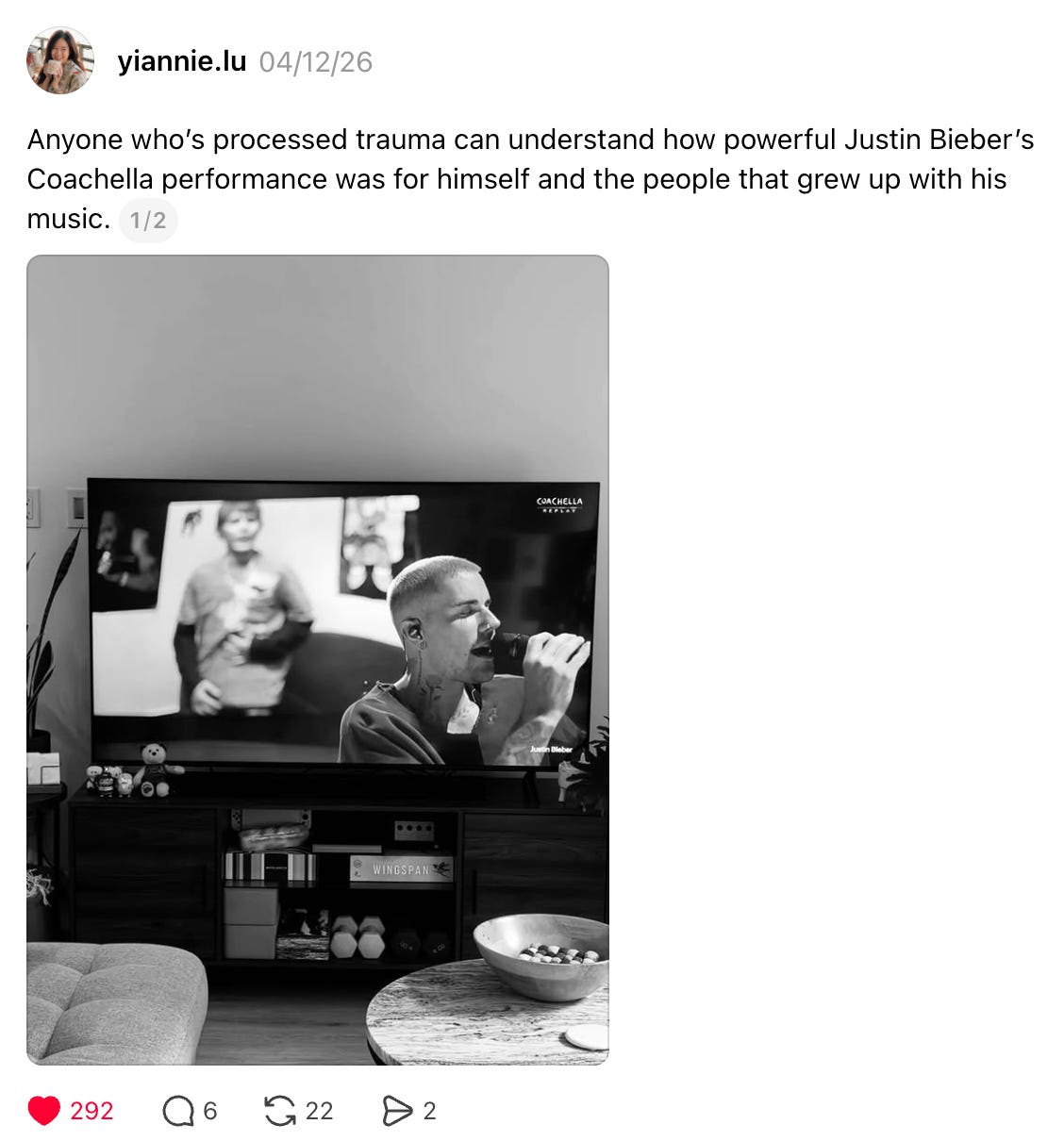
We saw a powerful example of this human need for authenticity with Justin Bieber’s recent performance at Coachella. His set generated a lot of buzz for being highly unconventional, as he essentially sang alongside old YouTube videos of his younger self.
While some critics dismissed the set as “weird” or “lazy,” those who grew up with his music understood the depth of what was happening. Watching him perform alongside his younger self felt like witnessing someone actively healing their inner child. The widespread emotional reaction to his performance shows that raw authenticity resonates far deeper than manufactured perfection.
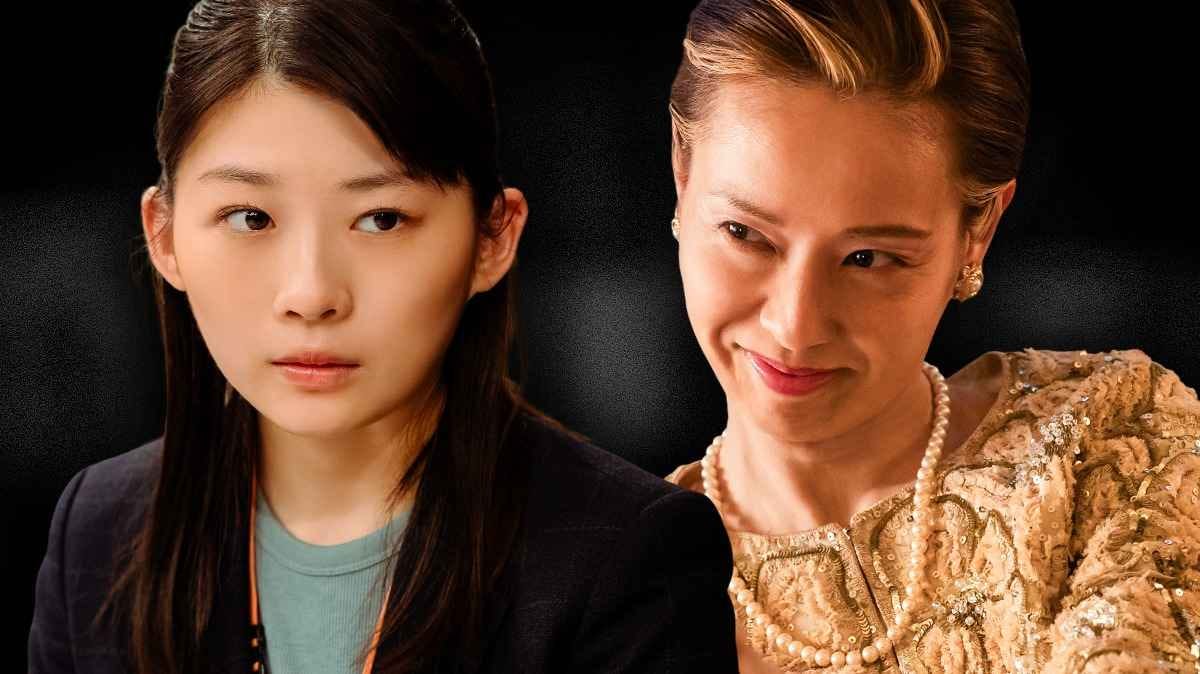
Another piece of art that beautifully mirrors this dynamic is Straight to Hell on Netflix, a Japanese historical drama inspired by the life of the famous fortune teller Kazuko Hosoki. For anyone who appreciates a complex female villain story, the show is a great watch. The plot follows Minori, a struggling writer hired to write Hosoki’s biography, who uncovers the dark truths behind how the woman built her immense wealth.
Hosoki represents the ultimate capitalist—her drive entirely rooted in financial accumulation after a childhood of poverty in post-war Japan. Minori, on the other hand, is the pure artist, committed to capturing the complex, unvarnished truth of a powerful woman’s life. By the end, I felt deep respect for Minori’s refusal to be intimidated or bribed into hiding the truth. Even Hosoki, who traded authenticity for fame and power, was moved to tears after reading Minori’s honest portrayal of her life. Minori’s journey was a masterclass in creative resistance.
“Writing stories for me is not just a means to an end. It’s about more than just money. It’s a part of who I truly am.” —Minori Uozumi, Straight to Hell (Ep. 9)
Choosing Joy and Advocacy
I recently interviewed Lauren, a friend who is actively involved in local politics, advocating for chronic illness as a commissioner for her local mayor. Something she said stuck with me when I asked her how to become more involved in the causes we care about:
“There’s a difference between advocacy and politics—and advocacy is important but it doesn’t have to be partisan. Find an issue that you really care about, and join an organization or volunteer for that cause. We are all different, and not all advocacy looks the same. What’s important is that you are advocating for change in ways that make the most sense for you.”
Similar to the message from the Creative Resistance zine, I find her framing of advocacy versus politics deeply empowering. I realized that advocacy, for me, means using my creative voice and storytelling to spread messages for causes that matter to me—through my writing, my art, and simply by living a life that aligns with principles I believe in.
If you are also thinking about how to resist systemic burnout and oppression, the simplest way is to start with yourself: prioritize your well-being, be intentional about how you spend your time, and invest in activities that nourish your creativity and soul. Creative expression is self-care. And self-care is resistance.
What is the simpliest way you engage in creative resistance? Send me a reply or comment below as I’d love to be inspired!
P.S. Ready to put creative resistance into practice? I’m launching a new series of creative reflection workshops next month. [Click here to join the waitlist] to be notified first!
Yes to all of this! Btw have you read the book Rest Is Resistance? I haven’t gotten to it yet, but a few people have recommended it to me.
👍 👍👍💕😘