

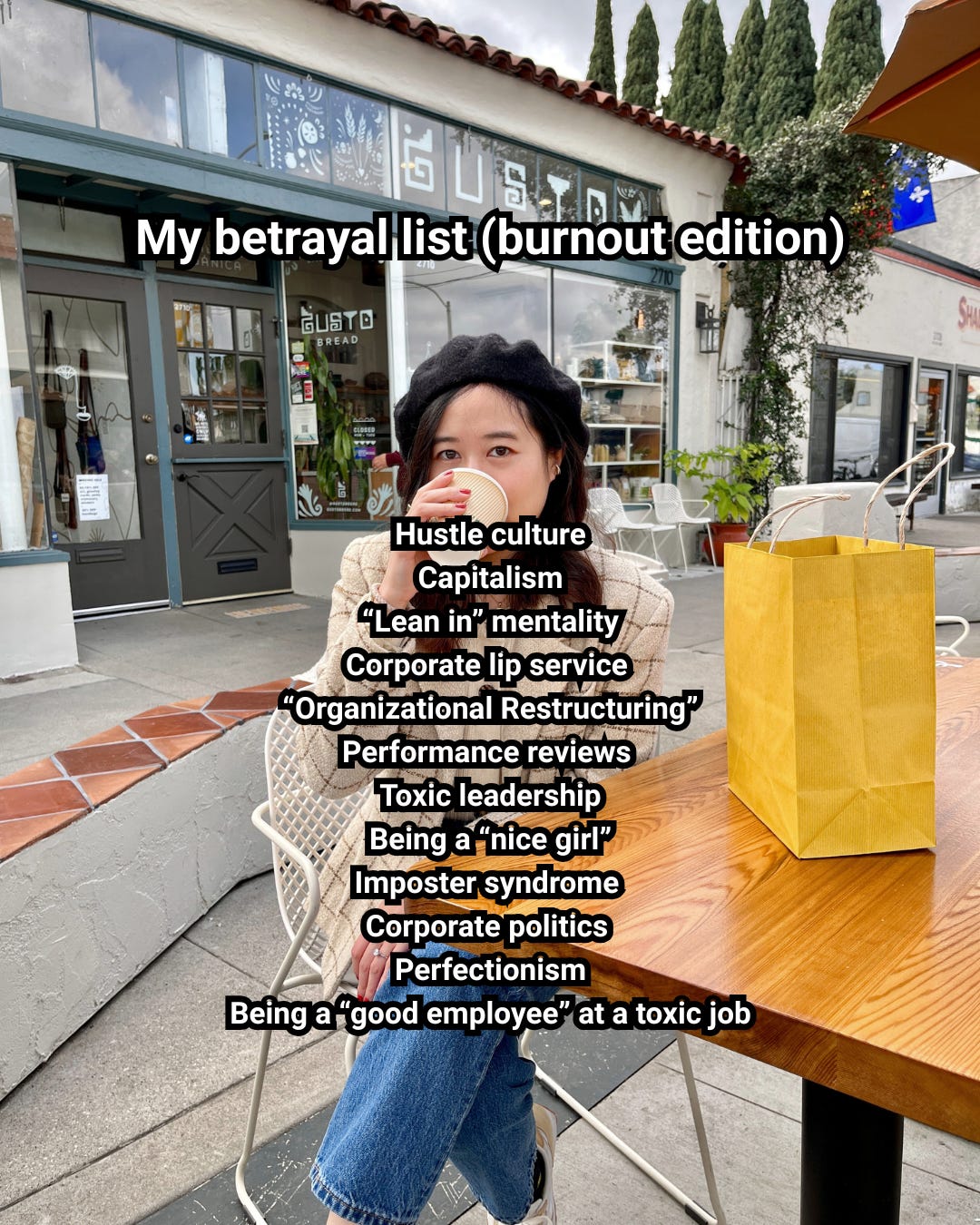
The Millennial Midlife Crisis
I grew up believing I would be living my dream life in my 30s—just like the romcoms and Disney Channel shows I watched as a kid. By now, I imagined I would own a beautiful home, have a high-powered job I loved, and a walk-in closet full of fancy clothes and shoes. I was told that if I worked hard, anything was possible for our generation.
Instead, I burned out and quit my six-figure job in big tech, moved apartments every year because renting was cheaper than buying, and spent my days doing everything I could to heal my inner child. My parents had two kids and a house in their 30s, and here I was having a midlife crisis at 33.
And I’m not unique. I’m part of a generation that did everything “right” and still got screwed. We feel stuck in a bad economy we can’t escape. And the most ironic part is that a lot of us can’t even afford a midlife crisis.
Millennials were taught that if you followed a certain blueprint, you would be successful:
Study hard. Get into a good college. Land a stable job. Climb the ladder. And if that’s not enough—get a master’s degree so you can make more money. Do all that, and you’ll be able to buy a house, have kids, and live the American Dream.
But the harsh truth is setting in: the American Dream is a myth. Mortgages, the cost of living, and childcare keep rising faster than our paychecks.
We’re stuck in the middle—too young to benefit from the booming economy our parents thrived in, and too old to fully opt out like Gen Z. We were raised to chase stability in a world that no longer offers it.
I invested in an MBA because I wanted to advance my career and finally afford to live alone instead of perpetually sharing apartments with roommates. Five years later, we’re in an economy where even top performers can lose their jobs overnight from layoffs or AI—and I’m still paying off $150K in student loans.
And it’s not just me. My friends—smart, ambitious graduates from prestigious universities—hustled into top companies because we believed financial freedom was the path to a good life.
But the reality? My hardworking friends at some of the world’s most well-known companies are still perpetually anxious about money. Some are buried under six-figure student loans. Some are afraid to buy a house because one layoff could wipe them out. Some stay in jobs they hate because they can’t afford the life they want without that paycheck. Some are constantly juggling impossible work-life expectations and the cost of childcare.
Not everyone is having a full-blown midlife crisis—but almost all of us are burned out and questioning the world we were told to trust.
The Myth of Hustle Culture
While we were busy working hard to build the lives we wanted, we were fed a constant message: hustle is a virtue. Look at the billionaires and founders who “made it”—they woke up at 5 a.m., worked out, stayed disciplined, and powered through with grit. That was the story we were sold.
I remember listening to business podcasts and watching productivity videos so I could learn the secret to building wealth and success. I internalized that my lack of energy to hustle for the mythical 5–9 after my 9-5 as my own fault—that I didn’t have the will or determination. But I was never lazy—I worked hard at my job and studied on weekends to apply for grad school so I could advance my career. But somehow that wasn’t enough.
What was always missing from those stories was the infrastructure beneath the hustle: privilege, safety nets, and generational wealth. Bill Gates built Microsoft with wealthy parents behind him. Mark Zuckerberg started Facebook at Harvard, surrounded by resources most people will never have. We were told hard work, grit, and vision got them there, when the reality is that most people simply don’t have that starting point.
I saw this firsthand when I co-founded a startup with two brilliant MBA classmates—one a Caltech-trained technical genius, the other a Brown grad and one of the best generalists I’ve ever met. We had a strong mission, won multiple pitch competitions, and raised venture funding. We had potential and we were committed.
But it wasn’t enough. We were immigrant minorities playing a game with rules that were never designed for us. We didn’t have a built-in network of well-off friends we could hire on vision and a handshake. And when funding dried up during a market crash, we didn’t have parents who could cover our rent so we could keep building without salaries. We had to get full-time jobs because we needed financial stability—no matter how much we believed in what we were creating.
So no—despite what billionaire founders preach, hard work and grit aren’t enough. You can’t be endlessly resilient when you’re worried about rent, bills, and the cost of being alive.
We were told the system was meritocratic—but what we didn’t realize was that the rules were rigged from the start.
The Lifestyle Trap Keeps Us Working More
Part of the hustle culture is this obsession with productivity and optimization. And capitalism frames consumption as self-improvement. We were told success looks like a high-paying job, a beautiful apartment, international travel, and a picture-perfect life. But these aren’t neutral aspirations—they’re products, sold to us through marketing, social media, and corporate greed.
Meanwhile, wages stagnated and the cost of living exploded. But our expectations never adjusted, because older generations insisted, “We did it, so you can too.” We were mocked for buying lattes and avocado toast while homeownership, retirement savings, and healthcare slipped further out of reach. So millennials coped the only way we knew how: through consumerism—wellness, travel, subscriptions, beauty, tech. When real stability feels impossible, we buy the illusion of it.
At the same time, we stay trapped in jobs because we’re still chasing the life we were promised. We tell ourselves that if we just grind a little longer, we’ll save enough for a house or finally get that income bump. Burnout becomes the norm, and the quickest way to numb it is retail therapy, self-care routines, and weekend getaways—small hits of dopamine that keep us going.
Instead of asking why work is so draining, we’re told to optimize ourselves so we can tolerate more of it. “Treat yourself” becomes the justification for staying in roles that exhaust us. And we end up dependent on the very jobs that are draining us—a self-perpetuating loop perfectly designed by capitalism.
The Dark Side of the FIRE Movement
On the other end of the spectrum, many millennials turn to the FIRE movement as a coping mechanism. Rewarding, meaningful jobs—like teaching or nonprofit work—often can’t support the cost of our lives. So the practical among us look for an escape hatch, and FIRE becomes the answer. At its core, FIRE (Financial Independence & Retire Early) promises financial literacy and freedom from work. But the path to FIRE often becomes its own full-time identity—optimizing every expense, obsessing over savings rates, and delaying joy in the name of discipline.
FIRE recreates hustle culture in a different outfit. It’s the same grind cycle, just rebranded as “responsibility.”
The FIRE movement became the millennial version of: if the system won’t save us, we’ll save ourselves. But saving yourself shouldn’t require abandoning your actual life. You start obsessing over your “end date” instead of being present. You restrict pleasure because of a hypothetical future where you’ll finally get to relax. You put your life on hold waiting to “hit your number.”
As someone who deeply believes in the value of financial independence, I’m only now realizing the unintended harm of the FIRE mindset. It conditions an entire generation to measure life by numbers—net worth, savings rate, spending efficiency—as if joy must be earned. It turns every decision into a spreadsheet. It convinces you that your best years should be spent grinding in jobs that drain you, all for the promise of a future freedom that may or may not ever arrive.
The FIRE mindset is, in many ways, the opposite of living in the present. Financial planning is important, yes—but not at the expense of actually living life.
Lean In: Making Women More Tired and Less Engaged
There are a handful of books that define a generation—and Lean In by Sheryl Sandberg became the defining text of “corporate feminism” in the 2010s. It was treated like gospel for career-driven women.
As a wide-eyed new grad entering tech, I read the book while imagining that one day I’d work at a mission-driven, world-changing company like Facebook—never realizing that just a few years later, the world would see the immense harm big tech has inflicted on our humanity.
Some of the advice was useful for women in corporate: raise your hand, speak up, ask for the raise. But the Lean In movement ignored a far more cynical truth: the system was designed to reward only one type of worker. Lean In framed women’s advancement as a matter of individual effort, placing all responsibility on women while overlooking the structural realities that keep many of us exhausted and excluded.
My frustration deepened after reading Sarah Wynn-Williams’ Careless People, where she recounts her experience working with Sheryl Sandberg and the toxic leadership behaviors she modeled for other working women. It exposed the gap between preaching empowerment and actually creating conditions where people can thrive.
Yes, we are responsible for our own well-being. But there’s a difference between sharing wisdom with humility and preaching from a place of privilege. It’s the same problem with billionaires who insist that hard work alone determines success—tone-deaf, unempathetic, and cruel.
Research backs this up: when women’s empowerment is framed as an individual responsibility, women become less likely to engage in activism that could actually dismantle systemic barriers. Instead of advocating for union rights, paid parental leave, or humane work policies, women were told to focus on perfecting the exact right way to ask for a raise without being labeled “unlikeable.”
If you want a deeper dive into this research, Stefanie O’Connell Rodriguez’s recent discussion of the Ambition Penalty on the Money with Katie Show is very much worth a listen.
So yes, millennial women are fucking tired. We leaned in. We stepped up. But instead of being rewarded, many of us were punished for our effort, our ambition, and our willingness to play by rules that were never designed for us in the first place.
Millennials are Fed Up — and We’re Waking Up
There’s always a breaking point in any relationship built on gaslighting. And millennials are hitting that breaking point now. Gen Z saw the cracks early and opted out before buying in. Millennials, raised on the promise of stability through hard work, are finally waking up to the lie.
I see it everywhere. Ambitious classmates from my MBA program are burned out in prestigious corporate roles and quietly plotting their escape. Working parents are grinding through jobs for paychecks and benefits because our government provides no meaningful support or paid time off.
Corporate work has become a glorified servitude where you trade your time, energy, and health for the illusion of stability and access to discounted healthcare and retirement savings.
Even in tech—a field once glamorized for its perks and innovation—people are dreaming of leaving. But breaking out of the system is terrifying when you’ve spent your whole life being told that the “safe path” is the only path.
Constant layoffs, AI disruption, and chronic burnout have made it clear: we need an alternative way to live and work. And we need it now.
But not all hope is lost—because history has shown us that systems eventually tip when they become too extreme. As corporations double down on efficiency and automation, they pay a price. The more they squeeze, the more high performers and valuable talent walk away. And with AI leveling the playing field, many will start their own ventures—smaller, more human, more sustainable. Maybe the paycheck is lower at first, but the autonomy, balance, and alignment are worth more than any corporate comp package.
Society will have to adapt as more people choose solopreneurship and small business over corporate dependence. We need systems that support flexible work, accessible benefits, and economic stability. We need accountability from the 0.001% who profit from a structure that leaves everyone else depleted. Because the old model isn’t just outdated—it’s actively harming a generation that did everything “right.”
Millennials are waking up from the lies capitalism sold us. Now it’s on us to write a new blueprint—one that values health, agency, and dignity over mere survival. Changing systems built to benefit the powerful won’t be easy, but we owe it to ourselves—and to future generations—to fight for a more equitable world.
Why I Left My Tech Career Without a Backup Plan

Two weeks ago, I left my six-figure corporate tech job in product marketing - without another offer lined up. It was a difficult but intentional decision, made after a lot of reflection during a recent leave from work due to burnout. After spending 10 years working my way up in tech, I knew it was time to pivot and explore a new chapter in my career.
“… I’d work at a mission-driven, world-changing company like Facebook—never realizing that just a few years later, the world would see the immense harm big tech has inflicted on our humanity.” — comforting to hear this sentiment from someone else
❤️❤️💪💪💕