

I turned 33 this month, and my gift to myself is a gap year.
Three months ago, I quit my high-paying PMM job in big tech after burning out. I decided to pivot away from an industry I’d worked hard to break into for the past decade (I shared more about that decision here). Since then, I’ve been experimenting with what a portfolio career could look like, because I believe it’s the long-term career path that truly allows me to embrace my multi-faceted interests and potential.
I’m being very intentional about how I approach my gap year: I will only work on projects that align with my values, even if that means turning away paid opportunities.
When I share this with people who reached out after reading my burnout story, the reactions are often: “That’s an extreme decision.” or “Good for you, but I could never do that.”
I get it. In a volatile job market, quitting a stable job in pursuit of a gap year sounds risky. But I also think this default fear response can sometimes do more harm than good—especially if it keeps people stuck in environments that are actively burning them out.
Of course, financial needs are real. In corporate America, 9–5 is still the most accessible way to earn a stable income and secure benefits, especially if you’re supporting a family. I have a lot of thoughts about why tying universal rights to employment is problematic (which I shared in this LinkedIn post), but that’s a conversation for another day.
I’m privileged to have enough of a safety net that I can choose autonomy over a paycheck (which is also the result of years of intentional decisions), and I think my story resonates with many mid-career professionals who have savings but feel trapped in burnout, unable to step away. There’s a reason why “quiet cracking” is now a widespread phenomenon.
For me, a gap year is the clearest path toward building what I call my “lazy girl boss career” because I know myself and how I work. Here’s why I see this year not as a pause, but as a long-term career investment:
1. We need space to reset, learn, and experiment.
Innovation and clarity only happen when we create space for them.
I recently heard a phrase that stuck with me: “To go three steps forward, you first need to go three steps deep.”
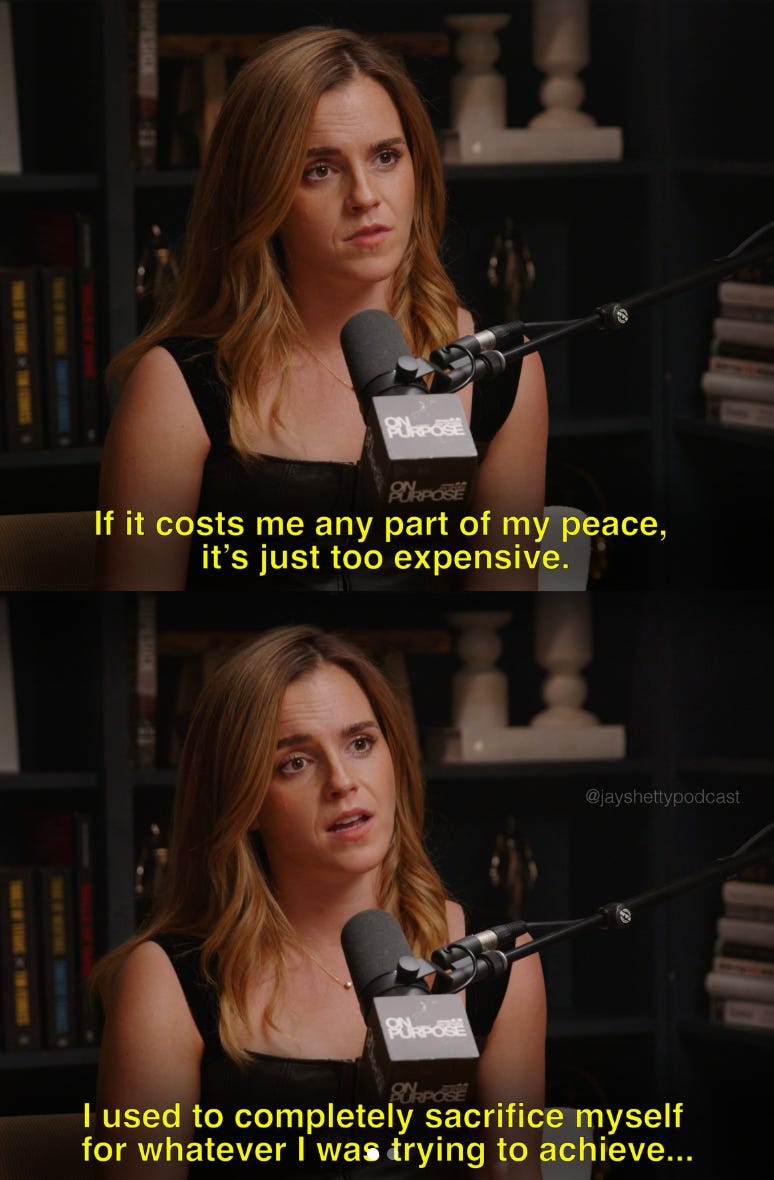
This came from Jay Shetty’s conversation with Emma Watson, where she opened up about why she stepped away at the height of her acting career. After experiencing health issues that stemmed from burnout, she chose to leave the spotlight—a decision that allowed her to redefine success, trust her intuition, and pursue work aligned with her values. Her story resonated deeply with me.
Time also creates space to heal, reset, and break patterns. Without it, we risk repeating the same mistakes. That’s why I’ve always believed in taking time after a breakup before jumping into a new relationship. The same applies to my career: pausing to reflect is what makes room for something better.
Even top tech companies understand this. That’s why they run hackathons and carve out time for employees to build what excites them. Google’s 20% time, Atlassian’s ShipIt days, and similar programs at Meta and Adobe have all led to innovative products people use every day.
If companies give their employees dedicated time to experiment, why wouldn’t I do the same for myself and my own career?
2. Focus on the opportunity cost instead of sunk cost.
Letting go of what you’ve built is scary. Loss aversion is deeply human. But reframing big decisions through opportunity cost vs. sunk cost has helped me approach change with more optimism.
The sunk cost fallacy reminds us not to keep investing in something just because of past effort. The smarter move is to make decisions that serve future you.
When I decided to quit, friends and family encouraged me to “coast until a layoff” or “build something on the side.” That advice might work for some people—but I know myself too well to believe it would work for me. After a decade in corporate, I’ve learned that people often give well-intentioned but ill-fitted advice. The key is knowing yourself well enough to filter what actually applies.
For me, the opportunity cost of staying in a role that drained me was simply too high. I knew I’d never have the energy to build something meaningful after a 9–5. I’m an all-in-or-all-out type of person, so I chose to go all in.
3. A chance to break patterns and practice mindset shifts.
My 20s were all about chasing milestones—career success, pay bumps, degrees, relationships, travel. It was exciting but exhausting, and eventually led me to burnout.
In my 30s, I don’t want to chase anymore. I want to be. I want to attract, not pursue.
But shifting deeply ingrained habits is hard. It’s easier to hide behind a paycheck, structure, and routine. Taking this gap year forces me to confront the fears behind those patterns. In a way, it feels like exposure therapy for my career.
Taking a gap year means I no longer have excuses to not pursue what I’ve always wanted:
“If only I had more time.” → Well, now I literally have all the time in the world.
“If only I could figure out how to monetize my interests.” → Without a consistent paycheck, I have no choice but to try.
“If only I could live the life I want.” → I landed what used to be my dream job and still burned out. So why not test a different path?
It’s a little extreme, but sometimes that’s exactly what it takes to rewire old patterns and let go of limiting beliefs that no longer serve us.
4. It’s a two-way door decision.
Amazon uses this framework to assess big risks:
One-way door decisions are permanent and high-stakes (like having a child).
Two-way door decisions are reversible, lower-risk, and great for experimentation.
To me, a gap year is a two-way door. One year might feel long, but in the span of a career, it’s short. And if I decide I want another 9–5 later, I can always find one.
In fact, most decisions we fear are actually two-way doors in disguise if we take a step back and reflect. So if you’re already curious about what’s on the other side of the door, why not just walk through and find out? You might be pleasantly surprised by the view.
5. Mid-career is actually the perfect time to reset.
Early in my career, I often heard the advice: “pivot when you’re young, because it’ll be harder later.” I used to believe that, but now I hold a different opinion—your 30s can actually be the best time to pivot.
By this point, most of us have built a strong foundation of transferable skills and resources—knowledge, experience, savings, and networks—that we can carry into something new. We’re not truly “starting over,” we’re building on a decade of momentum.
At the same time, we are still young enough to put in the work required to pivot into new career paths. There’s an idea originated from Malcolm Gladwell that mastery takes about 10,000 hours—or roughly 10 years. This means that if you pivot at 30, you could hit another peak by 40. How exciting is that?
And honestly, age is not a limiting factor. There are countless stories of people reinventing themselves in their 40s, 50s, even 70s. The mindset of “it’s never too late” might just be the most important ingredient in building a fulfilling life.
Why I’m Sharing This
You don’t need to quit your job to try these approaches. My philosophy is simply to know yourself deeply, and make choices that align with how you thrive. Sometimes, getting what we want in life requires taking risks—but reframing those risks can make decisions easier and help us avoid regret.
Lately, I’ve been meeting more and more mid-career professionals who feel the same: burned out from corporate, questioning the ladder, and exploring portfolio careers. The more conversations I have, the more I realize how important it is to build a community for people walking the unconventional path.
That’s why I’ve been running a small MVP with a few folks for the Burnout BFF Community—and I’d love your input.
👉 If you’re burned out by corporate life and curious about building a more intentional, portfolio-style career, please take 2 minutes to fill out the Burnout BFF Community survey.
My mission with Burnout BFF is to create a space that makes this journey a little less lonely for all of us. If this resonates, subscribe to get updates on the community and follow along with my gap year experiment!