

In honor of Women’s History Month, I want to talk about the Uterus Tax - the reality of being a woman in Corporate America today. Because knowledge is power, awareness is the first step toward healing, and rage is a highly effective motivator (this one is personal).

1. The Great Push-Out: Women are leaving the workforce at a record pace
You may have seen the headlines: between January and August 2025, over 455,000 women left the U.S. workforce. While a significant portion of these exits resulted from intensifying layoff cycles, 58% of women who left did so VOLUNTARILY.
Why would anyone give up a paycheck in this economy? Women are leaving not because of a lack of ambition, but because the system does not support them. According to a 2026 Catalyst study, 42% of women cited insufficient wages to cover skyrocketing childcare costs and inadequate workplace flexibility as their primary drivers for leaving.
In short, childcare has become so expensive that for many women, working is no longer mathematically justifiable. While there is profound value in being a full-time parent, the system is clearly failing women when that choice is a result of lack of options.
“Although many of these exits are labeled ‘voluntary,’ women often agonize over these decisions, stitching together caregiving solutions and managing their expenses, trying to succeed in jobs that fail to account for family responsibilities and economic pressures, until they reach a breaking point.” —Joy Ohm, VP at Catalyst
I’ve seen this pattern firsthand - brilliant female colleagues leaving high-paying roles because they are penalized for having caretaking priorities outside of work, while simultaneously carrying the guilt of no longer contributing financially to their households. It’s a mystery why the younger generation is overwhelmingly opting out of parenthood.
2. Sponsorship Gap, Double Bind Bias, and Flexibility Stigma
It’s not just mothers who are exiting the workforce; women across the board are hitting structural walls. McKinsey’s 2025 Women in the Workplace study revealed that Corporate America is actively rolling back progress.
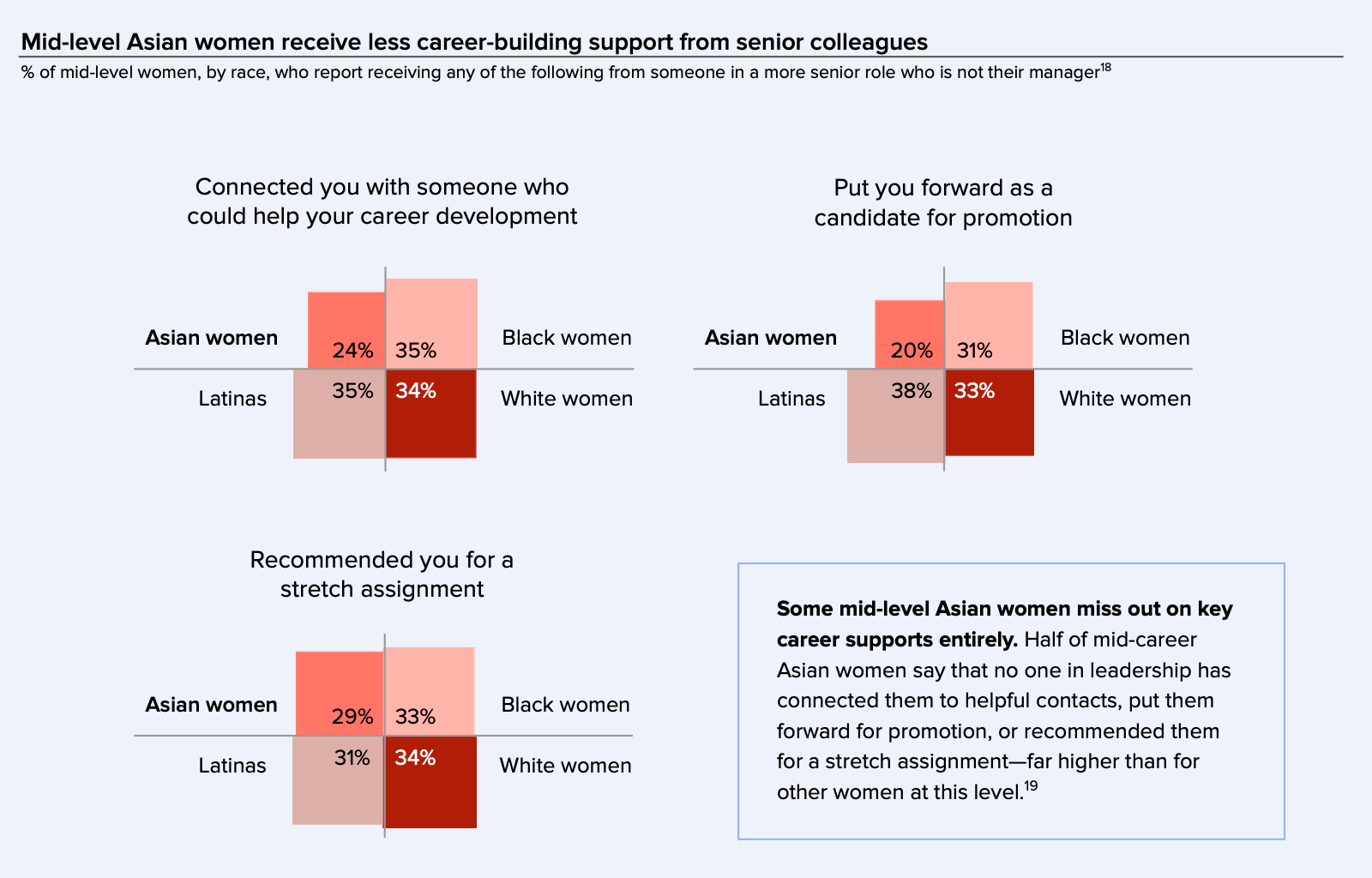
Women are significantly less likely than their male peers to have “sponsors” at work - leaders who actively advocate for their promotion. This hit entry-level women the hardest - but even for female executives who have successfully clawed their way up into senior management, they receive less support and fewer leadership opportunities.
Specifically, Asian women face even more barriers when it comes to advancing into leadership roles in corporate America due to the “Double Bind” bias. We are often told we lack the assertiveness required for leadership, yet we are penalized as aggressive or difficult when we do speak up and go against expectations. (Ask any Asian woman - she’s likely been given feedback to be “more visible” while simultaneously being silenced and ignored.)
It’s no secret that the Return to Office (RTO) mandate disproportionately impacts working mothers, but the data on “Flexibility Stigma” is even more eye-opening. The 2025 McKinsey report revealed that women who work remotely are promoted less frequently than those on-site, yet men suffer no such career penalty for the same arrangement. A woman working remotely is often assumed to be less engaged, while a man’s work commitment is simply taken for granted. We literally cannot win.
3. The Biological Toll: Female Burnout and Chronic Health Risks
The Uterus Tax doesn’t just impact our career trajectory or earning potential; more importantly, it directly affects our long-term health and well-being.
A 2024 CERP study found women are 3x more likely than men to experience clinical burnout, meaning one in seven women will have experienced a burnout collapse by age 40. This helps explain why women accounted for a staggering 71% of all mental health-related leaves.
“Working women – especially moms and other caregivers – often neglect their self-care until they hit the point of being so burnout they need to take a leave of absence.”
—Dr. Jennifer Birdsall, Clinical Director of ComPsych
The physical implications of this chronic stress are devastating. Research from late 2025 indicates that those with stress-related disorders have a 36% to 46% higher risk of developing autoimmune conditions. And guess what? Approximately 70% of all autoimmune patients are women. (These numbers still continue to surprise me even as someone who’s painfully aware of women’s health issues.)
Beyond immunity issues, chronic stress creates a domino effect across a woman’s entire life cycle:
Reproductive Burnout: Prolonged stress increases oxidative stress linked to higher rates of Endometriosis and PCOS (Frontiers, 2026). This creates a physical toll on fertility: high job strain significantly increases the likelihood of anovulation (cycles where no egg is released) even if periods appear regular (MDPI, 2025). Furthermore, women who report “high psychological distress” show lower implantation rates during IVF cycles compared to those with managed stress levels (NIH, 2026).
Menopause Penalty: Menopausal women are the fastest-growing workforce segment, yet they face a significant earnings penalty due to health symptoms. One in four women with severe symptoms considers leaving the workforce entirely due to inflexible environments (Stanford, 2025).
Having personally experienced clinical burnout and spoken with dozens of women who have faced the same struggle, I’ve seen firsthand how workplace stress fuels mental health challenges and negatively impacts our physical health. We can’t talk about one without the other.
Demanding workplace support for women’s health is no longer an optional conversation; it is a critical, urgent issue that impacts both current and future generations.
How do we fix a system not built for us?
Fixing women is not the solution. Patriarchy and capitalism have tried that, and it only resulted in a generation of exhausted, high-achieving women and a younger generation that views parenthood as an unattainable luxury.
Embrace our bodies: Our biology isn't “inconvenient” - the problem is a system that was never designed with our bodies in mind. Embracing our feminine strength and celebrating every part of our experience (even the difficult ones) is a form of resistance. We all know that if men menstruated, “bleeding holidays” and specialized benefits would be standard policy.
Demand systematic change: If the problem is the environment, then the burden shouldn’t fall on the individual. We need policies that prioritize health and well-being over “business as usual.” While companies offering flexible work, childcare subsidies, and fertility coverage see significantly higher retention, these benefits shouldn’t just be a privilege of private institutions - they should be the baseline.
Prioritize what matters: Stop pushing through at the expense of your health under the guise of productivity and increasing shareholder value. Instead, invest your time, energy, and resources into communities and causes that actively protect our well-being.
Burnout is an individual symptom of a collective disease. While self-care is a start, “community-care” is the cure. By talking openly about our health and our rage, we break the isolation that keeps us quiet and keep each other’s fires burning without letting them consume us.
Cheers to every strong, beautiful, and resilient woman reading this. Being human is hard, and being a woman brings unique challenges, but I am constantly inspired by the “uterus-holders” who are building authentic lives against the odds. While the numbers may look grim today, I am hopeful that every collective step we take will move the needle toward progress.

❤️👏👏👏💪💕